-
Englemann Spruce - Subalpine Fir
Back to Web Atlas
Englemann Spruce - Subalpine Fir
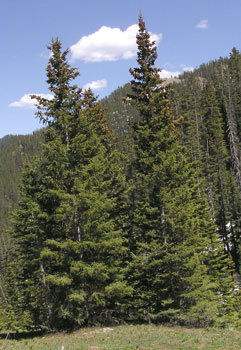
The Engelmann Spruce and sub-alpine Fir is a sub-alpine Fir Zone, which occupies the highest forested elevations in British Columbia. It is a larger biogeoclimatic zone in British Columbia, covered with old growth forest and crossed by fast flowing mountain rivers. This beautiful landscape contains much parkland and is important for recreation and timber harvesting.
Range
The Engelmann Spruce and sub-alpine Fir zones occupy the uppermost forested elevations in the southern three-quarters of the interior of British Columbia. They also cross over the border into the United States as well as East into Alberta. The zone contains very rugged terrain, and makes up many mountain ranges including the Selkirks, the Purcells, the Columbia, and the Rocky Mountain ranges.
Engelmann Spruce

Climate
This zone is known for its cold and snowy conditions for approximately half the year, where deep snow packs are common. Winters are long and cold and summers are short and cool. Mean monthly temperatures reach only 10 degrees Celsius for only about two months per year.
Vegetation
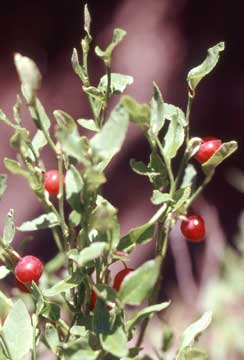
As the name of the zone implies, sub alpine fir and Engelmann spruce cover large parts of this zone; for the most part the lower and middle elevations of the zone. In addition, at higher elevations Krummholz is found. Krummholz trees are bushy clumps of prostrate conifers that grow near the treeline in areas where deep snow accumulates. Hitebark pine, limber pine, and alpine larch are also common in drier parts of the zone. In addition, limber pine and alpine birch do occur, as well as mountain hemlock, amabilis fir, western white pine, Douglas-fir, western hemlock, and western redcedar — all occur only in special circumstances. Smaller flora include White-flowered rhododendron, black huckleberry, grouseberry, false azalea, Indian hellebore, arrowleaved groundsel, subalpine daisy, paintbrush, foamflower, and Sitka valerian.
Grouseberry Bush Subalpine Daisy

Wildlife
Wet, cool summers, long, cold and snowy winters, steep terrain, as well as a relatively lush environment
make the Engelmann Spruce – Subalpine Fir Zone suitable for a wide variety of wildlife ranging from small
to large animals. Moose, black bear, and grizzly bear, are abundant in the summer. Rocky
Mountain elk, Rocky Mountain bighorn sheep, white-tailed deer, and stone sheep are restricted to particular
areas. Mountain goat, caribou, and mule deer find habitat in much of the zone. Marten, fisher, wolverine,
mountain beaver and ground squirrels are among the smaller mammals found here. Bird species include Gray Jay,
seed-eating birds such as the Red Crossbill, White-winged Crossbill, Pine Siskin, Clark’s Nutcracker and
Golden Eagles.
Caribou Wolverine


Resources
The most prevalent economic resource in this zone is the harvesting of timber. The lower elevations, especially sites that receive more moisture from upslope seepage, produce large amounts of harvestable Engelmann spruce and subalpine fir. Minor livestock grazing does also play a role, however significant skiing and outdoor recreation activities are another major resource of this zone. Skiing, camping, hiking, mountaineering, and hunting are popular activities of the Engelmann Spruce – Subalpine Fir Zone.
Skiing Hiking

